
Expertise provided by Justin, Admissions Director
Most pilots reach out after they have been told they need a HIMS AME, and they assume the examiner’s job is to find reasons to keep them grounded. That fear makes sense given the stakes, but it misses what this doctor actually does. If you are searching for a “HIMS AME near me” while a substance use diagnosis sits between you and the cockpit, here is the truth we learned by taking a pilot all the way through this process at Lions Gate Recovery in St. George, Utah: the HIMS AME is not the person who ends careers. Untreated or poorly documented recovery ends careers. The HIMS AME is the professional who translates solid recovery into a medical certificate.
We at Lions Gate Rehab are not going to sell you comfort or a quick path. We are going to explain how this relationship works, what the examiner reviews, and how the quality of your treatment record decides how much the AME can do for you.
What a HIMS AME Actually Does: Your Medical Sponsor, Not Your Adversary
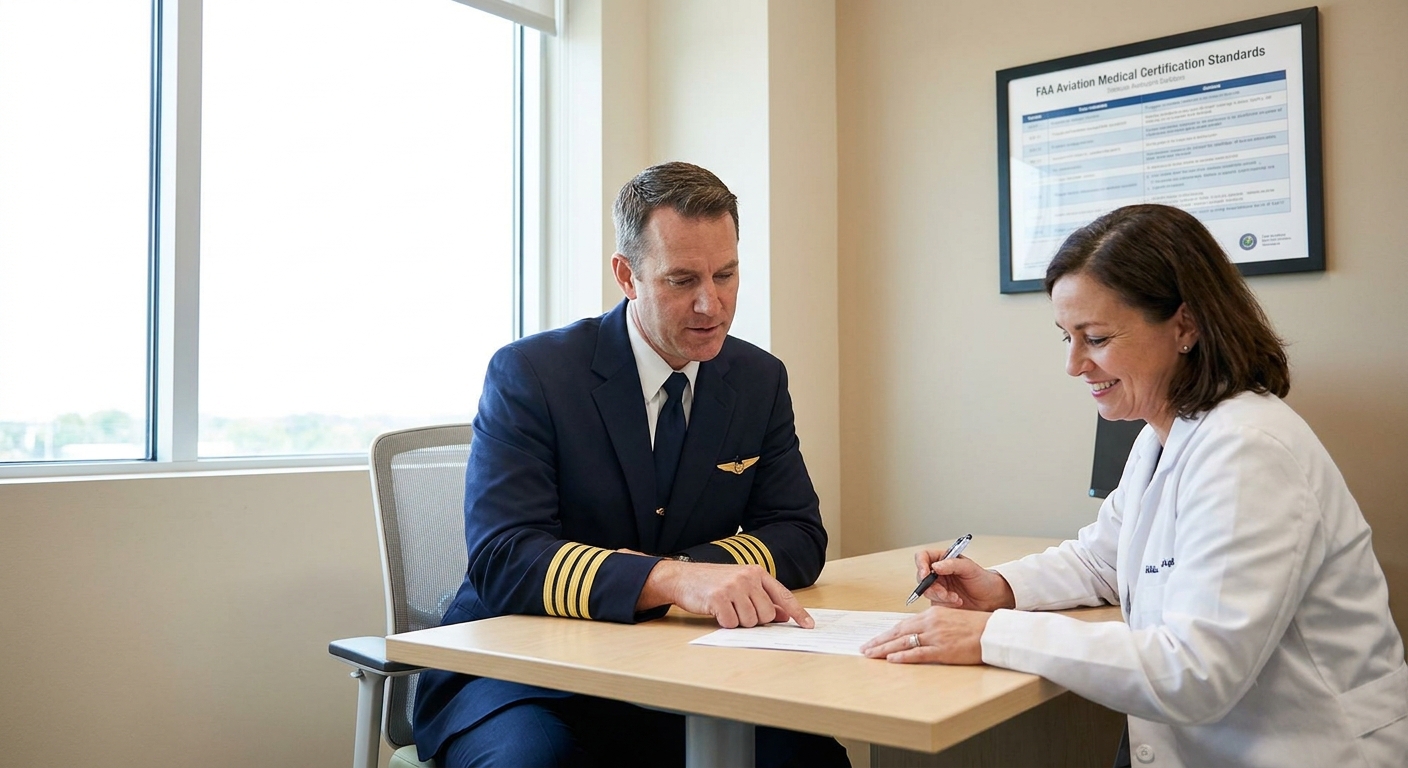
A HIMS AME is an aviation medical examiner with additional FAA training to evaluate pilots in recovery from a substance use disorder and to guide the Special Issuance medical certification process. Their function is medical sponsorship. They confirm you have reached and are holding the level of recovery the FAA requires, then advocate for your certificate when the evidence supports it.
Day to day, that means the AME reviews your treatment record, testing history, and clinical progress, sets clear monitoring expectations so you know exactly what is required of you, collects the ongoing evidence of abstinence and compliance, and submits a complete package to the FAA when you are ready. After Special Issuance is granted, that same examiner stays with you as your medical sponsor. The FAA created the Human Intervention Motivation Study pathway specifically so pilots who complete real treatment and then demonstrate sustained recovery can return to flying. You can read the FAA’s own guidance for these examiners in its HIMS AME materials.
When a pilot walks into our program at Lions Gate Rehab convinced the examiner is hunting for a reason to keep him grounded, we reframe it directly. The AME wants a complete, accurate record that lets him say yes. Anxiety usually comes from not understanding the role, not from the role itself. We saw this firsthand with the one pilot we have taken through the entire process. He arrived skeptical after a DUI-triggered evaluation put his medical at immediate risk, and he had already spent months trying to manage the situation on his own before he called us. Once he understood the AME was his advocate and not his adversary, the work got easier. He completed the full clinical continuum, maintained continuous documented abstinence with no adverse events, received his Special Issuance, and returned to the line.
What Documentation Does the HIMS AME Need, and When?
The HIMS AME needs a complete, accurately dated clinical foundation: your treatment timeline, diagnoses, a chain-of-custody testing log, progress narratives, and a detailed aftercare plan. They need it structured for FAA review, and they need usable pieces of it early rather than dumped on them at discharge.
The examiner is essentially asking one question of your file: does the evidence show you achieved abstinence, maintained it, and stabilized clinically? To answer that, they read your toxicology results with collection dates and chain-of-custody numbers, your attendance for required groups and individual sessions, your clinical progress, and your abstinence timeline. This is exactly why a treatment program has to build documentation for HIMS use from day one rather than writing a standard discharge summary and trying to retrofit it later. A retrofitted record leaves gaps, and gaps force the AME to send it back for clarification.
At Lions Gate Recovery, we lock the official abstinence start date to the first observed chain-of-custody negative test, not to what the pilot reports about himself. On day one you complete a full intake and an observed baseline panel that includes EtG or PEth and an expanded drug screen. On day two, that first negative result becomes the anchor date for every day of abstinence the AME will later count. From there we keep a running documentation folder updated throughout your stay. By day 21 to 28 of residential, the core package elements are already compiled: the timeline, diagnoses, any detox record, an early progress narrative, and baseline labs. Each summary we send is short and structured so it can be used immediately, and it typically carries your current continuous abstinence days, all toxicology results since the last report with their collection dates and chain-of-custody numbers, attendance for required groups and individual sessions, any clinical flags or a clear statement that there are none, a brief status on aftercare planning and sponsor engagement, and a concise clinical impression from the primary therapist or clinical director. We turn it around the same business day or within 24 hours whenever the AME requests an update, a toxicology result comes back positive, dilute, or invalid, or a significant clinical event affects monitoring. That habit is the difference between an examiner who moves your file forward and one who is stuck waiting on you.
After Special Issuance: How the HIMS AME’s Monitoring Role Continues
Getting your medical certificate back does not end the relationship with your HIMS AME. It shifts it. The examiner remains your medical sponsor, reviewing tests and attendance records, receiving reports, and communicating with the FAA as required, while the intensity of monitoring steps down over time as you demonstrate sustained recovery.
In practical terms, the monitoring that felt heavy at the start becomes the evidence that protects your career. Testing frequency is highest early, running two to three times per week under chain-of-custody during the intensive phases, then dropping as consistent compliance is documented. Aftercare continues, typically at one to two times per month after the intensive phases, with additional random testing. You maintain regular contact with a peer pilot sponsor and, when your airline is involved, a company sponsor, relationships that are usually required for Special Issuance and ongoing monitoring. You keep logs of consistent participation in AA, NA, or an equivalent group. Every negative test and every compliant report becomes part of the documented proof that lets you keep your medical and stay in the cockpit. Without that external structure, the FAA has no reliable way to grant or maintain Special Issuance.
Our completed pilot case at Lions Gate Rehab shows how this works in practice. He followed the standard continuum, then continued in weekly group and individual sessions with ongoing random testing and AME monitoring after his Special Issuance. Throughout that period he maintained continuous documented abstinence with no positive or dilute tests, no missed sessions, and no clinical flags, so every report we sent was a status confirmation rather than a red flag. The total calendar from first contact to full completion ran nearly five years, but the reason was personal: he chose not to resume flying for a period of time. The clinical work and the certification path itself were completed successfully. We reframe monitoring for every pilot the same way we did for him. It is not surveillance meant to catch you. It is the structure that protects the recovery you built and gives the FAA the objective, continuous evidence it requires.
How Do You Find a HIMS AME Near Me, and Why Is Regular AME Training Not Enough?
You find a HIMS AME through the FAA, which maintains a directory of examiners who have completed the specialized HIMS training. Not every aviation medical examiner is qualified for this. A standard AME can conduct a routine flight physical, but only a HIMS-trained AME is equipped to evaluate a pilot in recovery and manage the Special Issuance process. The FAA’s own HIMS AME resource explains the additional role these examiners take on.
When you search for a “HIMS AME near me,” proximity matters, but it is not the only thing that matters. You want an examiner with active HIMS training, real experience working with pilots in recovery, and a track record of moving complete Special Issuance packages forward. Ask how many HIMS cases they handle and whether they are comfortable coordinating with your treatment program during active treatment rather than only at the end. Pilot medical certification is a specialized area of aviation medicine, and the clinical literature on the subject underscores how structured and evidence-driven this process is meant to be. An examiner who does this work regularly will know exactly what the FAA expects to see.
The part most articles skip is coordination. The strongest outcomes come when the treatment program and the AME are talking while the pilot is still in treatment, not at discharge. Early coordination lets the monitoring plan and the package take shape in real time instead of arriving as one large dump at discharge. We at Lions Gate Rehab contact the HIMS AME early precisely so usable progress information exists throughout treatment. When you find your examiner, tell your treatment program immediately so that channel opens on day one instead of week sixteen.
Why Your Treatment Program’s Documentation Standards Decide What the AME Can Do for You
Your HIMS AME can only advocate as well as your treatment records allow. Poorly dated, incomplete, or generic clinical files force the examiner to request additional evaluations, chase missing pieces, or restart portions of the monitoring period, and every one of those delays keeps you grounded longer.
Think about what happens when a program hands the AME a standard 28- or 30-day discharge summary with a vague “continue outpatient” note and no chain-of-custody testing log. The examiner cannot submit that. There is no verifiable abstinence anchor, no documented testing cadence, and no measurable compliance markers, so the AME comes back with questions, or worse, tells the pilot the monitoring clock effectively starts over because the early record is not usable. That is exactly the gap pilots describe when they reach us at Lions Gate Rehab: no clear testing schedule or chain-of-custody process, aftercare that was optional and produced no usable documentation, no ongoing link to a HIMS AME during early recovery, and no clear sense of what the FAA would require next. That is the real career risk, and it has nothing to do with the examiner being an adversary.
The contrast is what a HIMS-capable program produces. In our completed case at Lions Gate Rehab there were no adverse triggers, so the file had been structured for HIMS use from the beginning, the abstinence date was anchored to the first observed negative test, and every toxicology result carried its collection date and chain-of-custody number. When the AME requested a current summary before submitting the Special Issuance package, we delivered it the same business day, complete and correctly dated, with continuous abstinence days anchored to that first observed test, the complete testing log showing all negatives, attendance, and a brief clinical impression confirming stability. Nothing was wrong with the documentation, so the examiner moved the package forward without coming back to us for a single record. That is the standard we now operate under for every pilot: aftercare recommendations written to the detail HIMS requires, with frequency, modality, sponsor involvement, and measurable compliance markers spelled out, testing that matches FAA chain-of-custody expectations, and a record the AME can actually use.
HIMS Treatment for Pilots at Lions Gate Recovery in St. George, Utah
Lions Gate Recovery is a HIMS-capable treatment program in St. George, Utah that treats the substance use disorder at a high clinical standard and builds the FAA-ready documentation the HIMS AME needs, coordinating with your examiner from day one of treatment. We serve pilots nationwide.
Our clinical continuum at Lions Gate Rehab is built for the level of accountability the HIMS process demands. Treatment starts with a full assessment and, if needed, on-site social detox, followed by 45 days of residential treatment with individual therapy, group work, evidence-based modalities, and daily structure. From there you step down into partial hospitalization for two to three months, then intensive outpatient for a minimum of 16 weeks. Random testing runs two to three times per week under chain-of-custody during the early phases and steps down as you demonstrate consistent compliance in coordination with your AME. We treat co-occurring conditions too, including depression, anxiety, trauma and PTSD, and bipolar disorder, because recovery that ignores what sits underneath the substance use does not hold up under years of monitoring.
Lions Gate Recovery is owned and operated by people in long-term recovery, with more than 70 years of combined sobriety among the ownership, and leadership stays involved in daily operations. We are not corporate-owned or investor-driven, and we do not build the easier softer way. This is a structured, accountability-focused program by design, because the FAA does not certify comfort, it certifies verified, durable recovery. We do not offer medically assisted treatment such as suboxone or methadone. What we offer is real recovery paired with a clinical file a HIMS AME can submit without chasing a single missing record.
Common questions pilots ask about the HIMS AME
What is a HIMS AME and how are they different from a regular aviation medical examiner?
A HIMS AME is an aviation medical examiner with specialized FAA training to evaluate pilots in recovery from a substance use disorder and to coordinate the Special Issuance certification process. A regular AME handles routine flight physicals but is not trained to manage recovery documentation and monitoring.
Does the HIMS AME decide whether I get my medical certificate back?
No. The HIMS AME reviews your recovery documentation and advocates for Special Issuance, but the FAA makes the final decision based on the evidence the examiner submits. The stronger and more complete your record, the more effectively the AME can support you.
How do I find a HIMS AME near me?
The FAA maintains a directory of HIMS-trained aviation medical examiners you can search by location. Look for an examiner with active HIMS training and real experience carrying pilots through Special Issuance, and tell your treatment program who they are so coordination can start early.
When should I contact a HIMS AME during treatment?
Ideally before or at the start of treatment, so the examiner can set monitoring expectations and coordinate with your program to ensure documentation meets FAA standards from day one instead of being reconstructed at discharge.
What happens if my treatment records are incomplete or poorly documented?
Incomplete or inaccurately dated records delay the Special Issuance process and may force the AME to request additional evaluations or restart portions of the monitoring period. That is why a HIMS-capable program locks the abstinence date to the first observed test and structures the file for FAA review throughout.
How long does the HIMS AME monitor me after I get my certificate back?
Ongoing monitoring typically continues for several years, with testing and check-ins that step down in intensity over time as sustained recovery is demonstrated.
If you are entering the HIMS program or have been referred to a HIMS AME near me, call Lions Gate Recovery in St. George, Utah at (866) 471-9476 to discuss how our HIMS-capable treatment program coordinates with your medical examiner from day one to build the clean, verifiable record the FAA requires. Before you make that call, do one concrete thing: lock down your first observed, chain-of-custody negative test as early as possible, because that date anchors every day of abstinence the AME will later count.
Individual results vary. The pilot case described reflects one person’s experience and is not a prediction of any outcome for another pilot.